
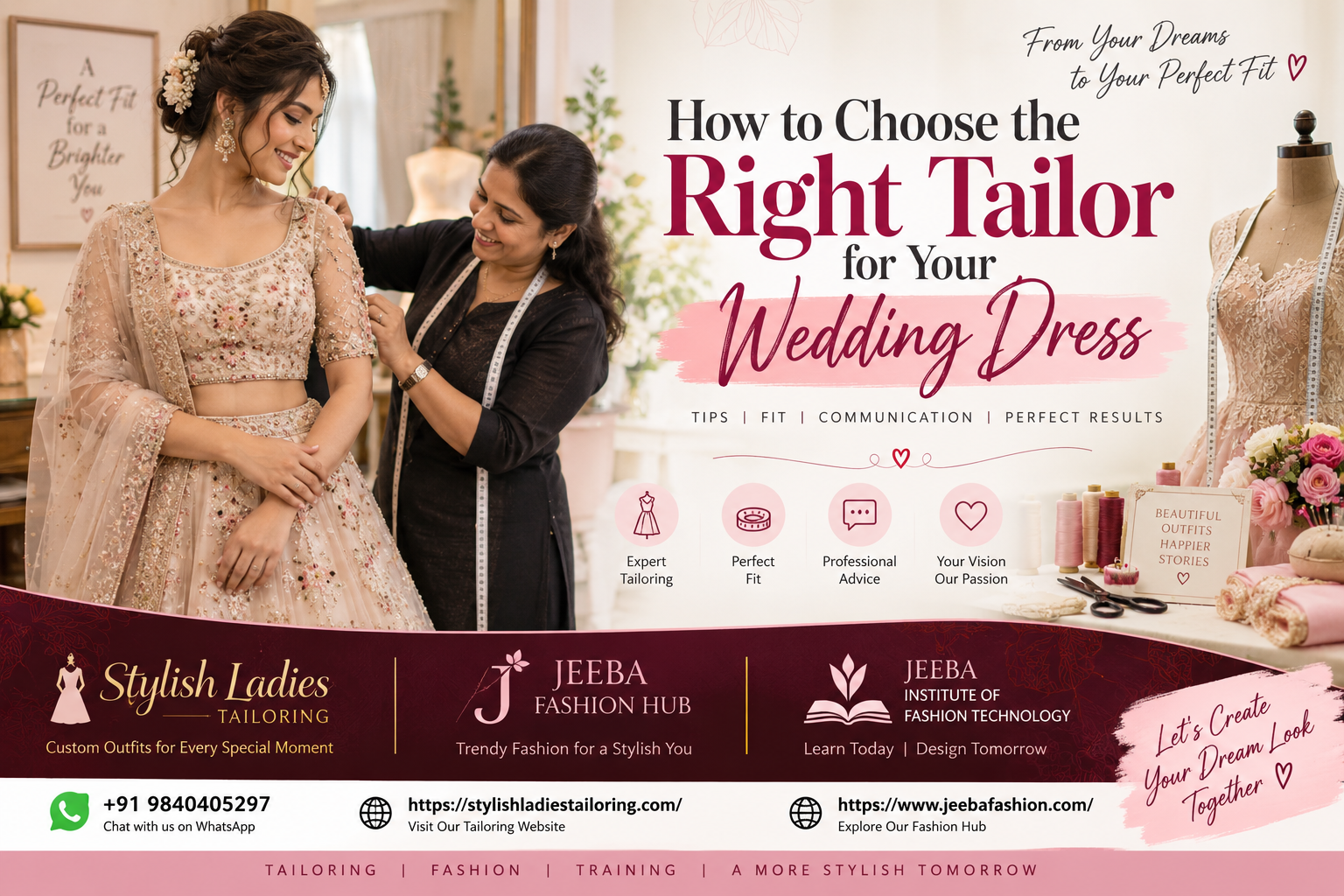
How to Choose the Right Tailor for Your Wedding Dress
Your wedding outfit is more than just another dress. It is something you may remember, photograph, and treasure for years.
So, when it comes to your wedding blouse, saree blouse, lehenga, gown, reception dress, or any other special outfit, choosing the right tailor is just as important as choosing the design.
Many brides blame the tailor when the final dress does not look the way they imagined. But sometimes, the real problem starts much earlier — the tailor and the bride were not the right match from the beginning.
A good tailor can make a beautiful dress. But a good tailor who understands your expectations, communicates well with you, and is experienced with your type of outfit can make the entire experience much better.
Here are some important things to consider before choosing your wedding tailor.
1. Don’t Blame the Tailor — Choose the Right Tailor First
Most professional tailors want their customers to look good. Nobody wants to deliberately make a wedding dress look bad.
However, not every tailor specializes in every type of garment.
A tailor who is excellent at everyday alterations may not necessarily be the best person for a heavily structured bridal blouse. Similarly, someone experienced in traditional blouses may not specialize in gowns, corsets, western dresses, embroidery-heavy garments, or intricate bridal designs.
So before giving your expensive wedding fabric to a tailor, ask:
- Have you made this type of garment before?
- Can I see examples of your work?
- How many fittings will we have?
- How will we finalize the fit?
- What changes are possible with my fabric and design?
- Can you suggest improvements if something may not work?
The right tailor should be able to explain the process clearly.
2. Don’t Skip the Trial — Perfect the Fit Before the Final Dress
One of the biggest mistakes a bride can make is waiting until the final garment is completed to discover that the fit is not right.
For important wedding garments, fittings are a crucial part of the process. A fitting allows the tailor to check the garment on your actual body and make adjustments before the final finishing.
For some custom garments, a trial garment or toile/muslin sample can be used before cutting into expensive final fabric. This allows important decisions about fit, neckline, proportions, structure and comfort to be corrected early.
So remember:
Don’t just approve the design. Approve the fit.
Try sitting down. Move your arms. Walk. Check the neckline, sleeves, shoulders, waist and overall comfort.
And if you are wearing specific footwear or undergarments with the final outfit, bring them to the relevant fitting when possible, because they can affect the final fit and length.
3. Your Chemistry With Your Tailor Matters
This is something people often underestimate.
Your tailor may have excellent technical skills, but if you cannot communicate comfortably with them, the process can become stressful.
Your wedding outfit may require several conversations and fittings. You need to be able to say:
“I don’t like this.”
“Can we change this?”
“I’m not comfortable here.”
“Can you suggest something better?”
And your tailor should be comfortable giving you an honest answer.
Good bridal consultations are collaborative. The process often involves discussing the design, fabric, structure, fit, styling and practical considerations together.
So don’t choose a tailor only because someone says, “They are very good.”
Meet them.
Talk to them.
Show them your reference pictures.
Explain what you want.
Then see whether you feel comfortable working together.
4. Treat Your Tailor Like a Consultant, Not Just a Person Taking Measurements
This is perhaps the most important point.
A tailor is not simply someone who takes your measurements and stitches exactly what you say.
An experienced wedding tailor should be able to contribute professional knowledge.
For example, you may show a reference picture and say:
“I want exactly this neckline.”
But an experienced tailor might notice that the neckline needs to be adjusted for your garment’s construction, fabric, body proportions or the way you want to move in it.
That advice can be valuable.
So instead of treating your tailor like someone who simply has to follow instructions, treat them as a technical consultant who can help turn your idea into a wearable garment.
Of course, the final decision is yours. But you should be open to professional suggestions.
5. A Good Tailor Should Listen — But Shouldn’t Always Say “Yes”
There is an important difference between listening to the customer and blindly following every instruction.
Your tailor should first understand what you want.
But if something is technically difficult, uncomfortable, impractical, or unlikely to give the result you expect, a good tailor should tell you.
In fact, an honest “I don’t recommend that” can sometimes be more valuable than an immediate “Yes.”
You want someone who can say:
“This will work.”
“This needs a small change.”
“I recommend this option instead.”
“Let’s test it during the trial first.”
That is the kind of professional relationship you want for an important wedding outfit.
6. Ask About the Number of Fittings
Don’t assume that one measurement appointment means your dress will be perfect.
The number of fittings depends on the garment, its construction, how much alteration is required, and how complex the design is. Bridal specialists commonly use multiple fittings, particularly for more complicated garments.
Before you confirm your order, ask your tailor:
“How many fittings do you recommend for this dress?”
A clear answer helps you plan your time and reduces last-minute stress.
7. Choose Communication Over Guesswork
Bring your inspiration pictures, but don’t simply show a photograph and say:
“I want this.”
Explain what you like about it.
Maybe you like:
- the neckline
- sleeve design
- waist shape
- silhouette
- embroidery placement
- back design
- overall elegance
- the way the outfit moves
This gives your tailor a much better understanding of your actual preference.
Reference images are useful starting points, but a professional may need to adapt elements to your garment, fabric, proportions and construction.
The Golden Rule for Choosing Your Wedding Tailor
Don’t ask only:
“Is this tailor good?”
Ask:
“Is this the right tailor for MY wedding outfit?”
Look for someone who:
Understands your design.
Has experience with your type of garment.
Communicates clearly.
Welcomes fittings and corrections.
Gives honest professional advice.
Makes you comfortable.
Takes responsibility for the finishing and fit.
Your wedding outfit is a collaboration between your vision and your tailor’s expertise.
When both work together with trust, communication and respect, the result can be much better than simply giving instructions and expecting a perfect dress.
Final Thought
Don’t wait until your wedding dress is finished to find out whether you chose the right tailor.
Choose carefully.
Have a proper consultation.
Do the trial.
Check the fit.
Listen to professional advice.
And most importantly, build a comfortable relationship with the person who is creating one of the most memorable outfits of your life.
The right tailor doesn’t just stitch your dress.
The right tailor helps bring your vision to life.

Very nice article for bridal